A new physical foundation.
Three scientific domains.
FluxMateria is built on FLUX, a novel physics theory. Its shared physical foundation supports a broad family of applications: reaction chemistry and spectroscopy, materials and device design, ADMET and target discovery. Compare the established methods, explore the capabilities, and examine the evidence for each.
What makes FLUX a different physical approach
FLUX is a novel physics theory; FluxMateria is its computational implementation. Geometry appears in many scientific methods. The distinction lies in the physical relationships that turn a system’s description into predictions. For FLUX, the originality claim concerns that underlying theory and its derived calculations.
| Technical question | Established approaches | FLUX / FluxMateria |
|---|---|---|
| What is the role of geometry? | Tools such as ETKDG construct plausible molecular conformations. Force fields and electronic-structure methods also use geometry, for different calculations. | Geometry has a physical role within FLUX theory. The contribution is the theory that determines the supported properties, beyond constructing coordinates or descriptors. |
| What generates the predicted values? | Additive methods combine property contributions; force fields evaluate parameterized interactions; electronic methods solve an approximate electronic problem; ML evaluates a trained model. | An original physical theory supplies the shared basis for the kernel’s property calculations.Application modules can add endpoint-specific readouts and reference-assisted components. |
| What happens to the iterative electronic calculation? | DFT and self-consistent tight-binding methods obtain an electronic solution within their chosen approximations. Other fast methods can already avoid that calculation. | Supported direct-prediction routes compute the requested properties from FLUX physics without a conventional electronic self-consistency cycle for each query.Wider workflows can still require configuration searches or iterative simulation. |
| What does “zero fitted parameters” distinguish? | Empirical force fields and learned models use fitted parameters. First-principles electronic calculations need not be trained to the target property. | No-fit claims apply to declared physics-derived routes.Hybrid, calibrated and reference-assisted modes remain explicitly scoped. Absence of fitting alone does not establish a novel theory. |
| How does the foundation extend across applications? | Established platforms also cover chemistry, materials and life science, using portfolios of computational methods. | The same FLUX physical foundation supports modules across all three domains, with module-specific inputs and validation.Explore the capability map. |
| What can be checked publicly? | A meaningful comparison fixes the task, inputs, reference data, settings and scoring. | Published property profiles, runtime measurements and matched accuracy comparisons.Materials versus PBE · Torsion versus force fields. |
Two separate questions deserve separate evidence. Benchmarks test what FluxMateria predicts and how efficiently it does so. Establishing the precise mathematical novelty requires examination of the protected formulation, its derivations and its relationship to prior work. This public comparison explains the scientific approach and presents performance evidence; it does not substitute for that technical review.
Seven established approaches, and the FLUX alternative
Scientific prediction spans several method families. This overview identifies representative tools, their outputs and their scientific basis. FluxMateria is highlighted in violet; the following tables show its differences and measured results.
| Method family / examples | What it provides | Scientific basis |
|---|---|---|
| Distance geometryRDKit ETKDG | Candidate three-dimensional molecular conformations. | Distance constraints and torsion knowledge. RDKit documentation. |
| Additive descriptorsWildman–Crippen | Estimates of logP and molar refractivity. | Published atom-based contributions. Method documentation. |
| Empirical force fieldsSage, GAFF2, MMFF94 | Molecular energies, forces, geometry optimization and simulation within supported chemistry. | Parameterized molecular interaction models. OpenFF release and training documentation. |
| Semi-empirical electronic methodsGFN2-xTB, DFTB | Efficient approximate electronic-structure calculations, with method-specific property coverage. | Parameterized quantum-chemical approximations. GFN2-xTB paper; DFTB overview. |
| Density functional theoryExample: Quantum ESPRESSO | Electronic states, energies, forces, stresses and associated material properties. | Electronic-structure calculations within a chosen density-functional approximation. Capabilities and methods. |
| Machine-learned potentials | Fast estimates of energies and forces for atomistic simulation. | Models fitted to reference calculations; accuracy and transferability depend on model and data. Primary research. |
| Learned property modelsExample: Ma et al. band-gap model | Property estimates from descriptors such as chemical composition. | The cited model fits one parameter per element to data. Original paper. |
| FluxMateriaFounded on FLUX theory | Chemistry, materials and life-science predictions through a family of application modules. | A novel physics theory and shared deterministic physical kernel. No-fit, hybrid and reference-assisted modes are distinguished by endpoint. Published benchmarks. |
The table describes method families, not interchangeable products. The materials comparison below evaluates a specified GPAW PBE setup; the torsion comparison evaluates Sage 2.2.0, GAFF2 and MMFF94. These results establish performance on their declared tasks and cohorts, rather than a universal ranking of method families.
From reaction chemistry to materials design and pharmacology
FluxMateria’s scope extends across the following capability families. The links lead to the relevant modules and evidence; readiness and validation belong to the particular endpoint and use case.
| Domain / capability family | FluxMateria capabilities | Scope and evidence |
|---|---|---|
| ChemistryReactions and synthesis | Mechanism discovery, activation barriers, reaction-condition exploration and synthesis planning. | MechanismOS and Synthesis Planning.Mechanism classification, quantitative barriers and route proposals are separate outputs with separate evidence. |
| ChemistryMolecular and solution properties | Molecular properties, rotational barriers, solvation, solubility and pKa. | Solvation and torsion-barrier validation.Support depends on chemical class, solvent and endpoint. |
| ChemistryCharacterization and transfer | UV–Vis, IR, Raman and NMR predictions; electron-transfer calculations. | Spectroscopy and Electron Transfer.Validation is specific to the technique and chemical systems tested. |
| MaterialsBulk properties | Band gaps, electronic classification, formation energies, lattice properties, and thermal, mechanical, magnetic and dielectric outputs. | Materials Engine and property benchmarks.Prediction basis and reference coverage vary by property; the universal benchmark path is mixed. |
| MaterialsSemiconductors, interfaces and devices | Carrier mobility, doping and temperature sweeps, surface work functions, band alignment, contacts and solar-device response. | Semiconductor Design, Surface & Contact, and Solar Device Studio.Solar-device qualification is internal and restricted to its supported silicon-device scope. |
| MaterialsApplications and discovery | Battery electrochemistry, catalyst assessment, inverse search and candidate design. | Battery Electrochemistry, Catalyst Scoring, and Inverse Search.Production and pilot capabilities coexist. Application outputs can include reference-assisted or calibrated components. |
| Life scienceADME and exposure | Permeability, solubility, plasma protein binding, blood–brain barrier penetration, metabolism and clearance assessment. | ADMET and Caco-2 permeability.Physics-only and hybrid readouts are distinguished by endpoint and mode. |
| Life scienceSafety and interactions | Liver-injury risk, hERG liability and CYP interaction profiling. | DILI evidence and ADMET evidence.Screening outputs have assay- and population-specific scope; they do not establish clinical outcomes. |
| Life scienceTarget discovery and optimization | Docking, binding affinity, selectivity panels, repurposing and target-profile search. | BioTarget and Flux Pharmacology.Binding, selectivity and repurposing capabilities include beta workflows; validation depth varies by target family and binding mode. |
40+ material properties.
One composition. About 3 milliseconds.
FluxMateria returns a broad material profile from a chemical formula. The DFT cross-check benchmark puts that capability alongside locally executed GPAW PBE calculations on 15 fixed materials, with experimental references. It brings together three distinct questions: how much the call returns, how long it takes, and how closely the tested predictions match experiment.
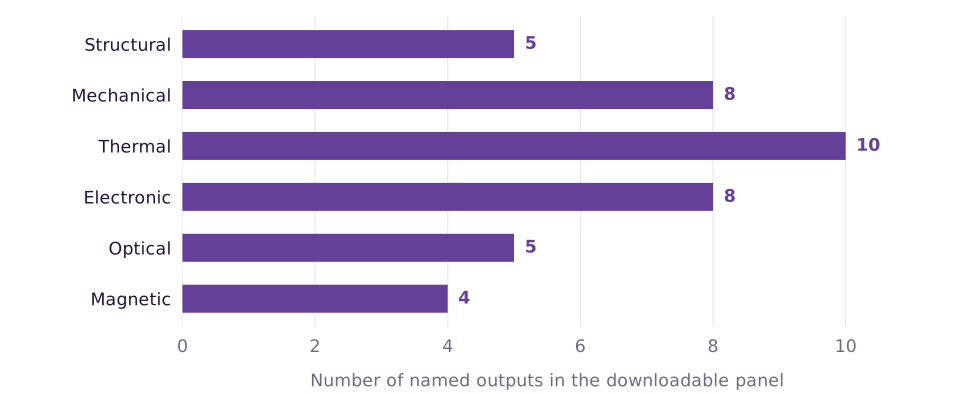
Examples include lattice properties, elastic moduli, thermal conductivity, band gap, carrier mobility, dielectric properties and magnetic response. Counts come from the downloadable property panel. Accuracy is established separately for each property and material class.
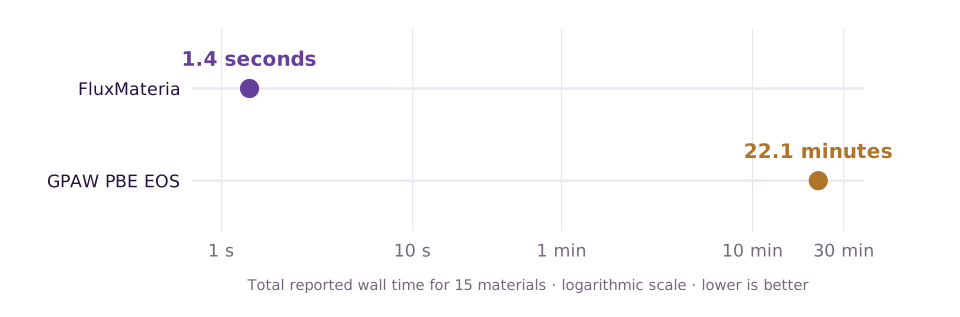
The timed DFT task is a seven-point equation-of-state scan for bulk modulus and relaxed lattice: GPAW PBE, 200 eV and a 6³ k-point mesh, with the documented hexagonal adjustment. Seven of 15 DFT EOS fits converged at this screening setting. This is the measured Tier 2 workflow, not a timed DFT calculation of all 40 properties. The full benchmark reports approximately 25,000× mean speedup per material separately from the approximately 950× batch ratio including startup. CPU execution is documented; the CPU model is not specified.
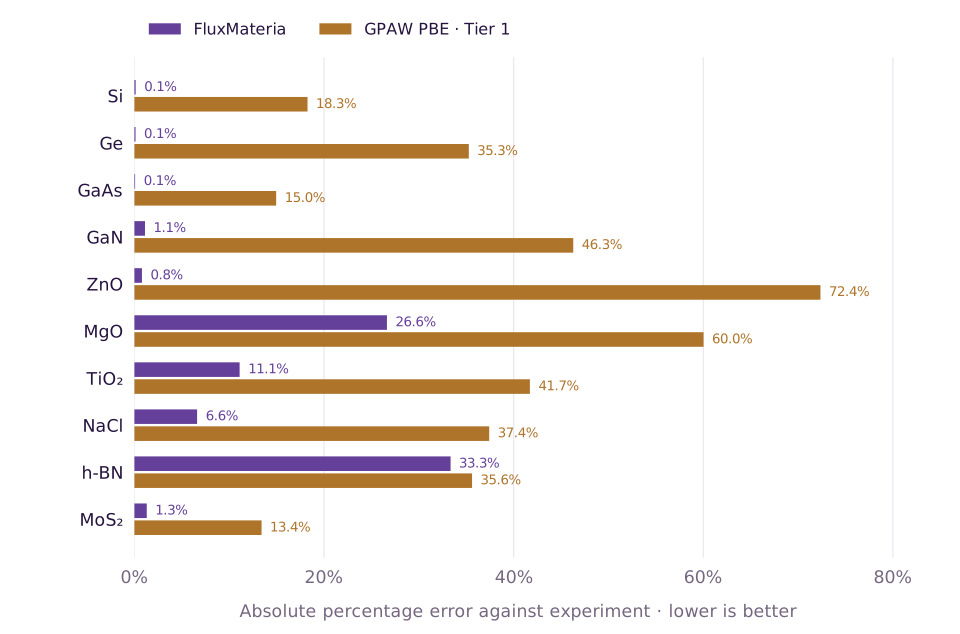
Recomputed from the May 2026 Tier 1 rows: all ten positive experimental gaps with predictions from both methods, with no mixing of Tier 1 and relaxed Tier 2 cohorts. The MAPE difference is 29.41 percentage points, a 78.4% relative reduction. This internally executed result evaluates the stated PBE screening setup; it does not establish the same advantage over hybrid DFT or GW.
What the materials comparison measures
- Breadth: the full profile spans six property families. The downloadable panel enumerates 40 outputs; the full benchmark describes the platform capability as 40+. This is not a claim that every output has the same accuracy or has been compared head-to-head with DFT.
- Time: approximately 3 ms is a typical prediction-call time after startup. The reported 1.4-second batch includes startup and is compared with the reported 22.1-minute PBE EOS batch. Estimates for more expensive DFT settings and a complete DFT property suite are presented separately on the full benchmark page.
- Accuracy: the graph uses the saved Tier 1 single-point export, with the DFT lattice fixed to experiment. The zero-gap cases are excluded from percentage gap errors. No lattice-accuracy advantage is inferred from a DFT lattice fixed by construction.
- Validation: these are FluxMateria-run comparisons against a declared computational baseline and experimental references. The plots do not constitute independent blind replication or a performance test of every competing platform.
Three domains under one roof. A distinct physical foundation.
Large scientific software platforms also span chemistry, materials and life science. FluxMateria brings its own original physical theory to that breadth. This table compares documented coverage and scientific approach; the numerical evidence follows separately.
| Comparison | FluxMateria | Schrödinger | BIOVIA |
|---|---|---|---|
| Chemistry | Reaction, solution and spectroscopic calculations.Flux Chemistry | Quantum chemistry and molecular property calculations.Jaguar | Chemical modeling, catalysts and molecular materials.Materials Studio |
| Materials | Bulk properties, semiconductors, interfaces, battery and catalyst applications.Flux Materials | Materials design, including polymers, electronics, energy storage and catalysis.Materials platform | Materials modeling across polymers, metals, semiconductors and batteries.Materials Studio |
| Life science | ADMET, safety, target binding, selectivity and repurposing, with endpoint-specific readiness.Flux Pharmacology | Drug discovery, optimization and biomolecular modeling.Life-science platform | Drug design, biomolecular simulation, QSAR, ADMET and toxicology.Discovery Studio |
| Scientific approach | An original physical theory, FLUX, shared across application modules.Direct physics predictions coexist with explicitly scoped application components. | A computational platform with quantum chemistry, molecular simulation and drug-design tools.Platform portfolio; quantum-chemistry engine. | Integrated modeling environments combining multiple simulation and predictive methods.Materials methods; life-science methods. |
Coverage reflects the linked public product descriptions reviewed on 1 October 2026. Coverage in the same domain does not imply identical endpoints, inputs or accuracy. No matched performance study of these complete commercial platforms is presented here.
Time to compute. Work to get started.
Runtime and preparation both matter when choosing a scientific tool. The examples below come from published benchmarks, product documentation and tutorials. These are different workloads, not a matched speed test. They show the available evidence without converting unrelated tasks into a speedup claim.
| Domain | FluxMateria | Schrödinger | BIOVIA |
|---|---|---|---|
| Chemistry | Spectroscopy: approximately 25 ms per prediction on a single CPU.Product-page figure; CPU model and timing protocol are not specified. Spectroscopy module. | Jaguar AutoTS: approximately 5 minutes on a 12-CPU host for the tutorial’s Diels–Alder reaction.A specific tutorial example, not a typical time for all reactions. Vendor lesson, p. 18. | DMol³ chemistry calculations: no absolute per-job runtime in the reviewed product sheet.DMol³ product sheet. A workload-specific measurement is needed. |
| Materials | About 3 ms per call for the reported 40+ property profile; 1.4 seconds for the 15-material batch including startup.Measured DFT comparison and graphs. The tested comparator there is GPAW PBE, not either commercial suite in this table. | Polymer-property workflows: no absolute runtime in the reviewed overview.The documented workflow includes model building and molecular simulation. Polymer modeling. | CASTEP materials calculations: no absolute per-job runtime in the reviewed product sheet.CASTEP product sheet. This is a data gap, not evidence of slow performance. |
| Life science | Caco-2 permeability: reported throughput of 97 molecules per second.A single endpoint, not a docking or full-ADMET timing. Hardware is not specified in the saved benchmark summary. | Glide self-docking: mean CPU time per ligand of 27 s (SP), 158 s (XP), and 631 s (WS).Vendor study: 765 complexes, 61 targets, cloud CPU; CPU model unspecified. Published table, p. 3. | Discovery Studio docking: no absolute per-ligand runtime in the reviewed overview and training catalogue.Product overview; training catalogue. |
Tutorial wall time, CPU time, per-call latency and batch throughput are different measurements. Preparation, queueing, parallelism, system size and requested accuracy also affect time to result. A fair speed comparison must hold the endpoint, inputs, accuracy target and hardware budget constant.
| Purpose | FluxMateria | Schrödinger | BIOVIA |
|---|---|---|---|
| ChemistryMolecular properties and reactions | For spectra: a SMILES string or structure file and the requested technique. Reaction tools additionally need the chemical participants and conditions.Spectroscopy inputs; reaction workflow. | Jaguar tutorial: prepare structures, choose the quantum method and basis, check charge and spin, configure the job. AutoTS automates reaction-path searching.Documented tutorial workflow. | Build a molecular model and configure a DMol³ task in the graphical interface. Materials Studio 2026 also adds automated recovery for some convergence failures.Modeling interface; 2026 automation. |
| MaterialsProperties and design | Composition for the supported bulk-property route; specialized tools add relevant operating conditions, surface or device choices.Materials input; specialized workflows. | For polymer simulation: build the system, equilibrate it, run a property workflow and analyze results. MS Maestro supplies builders and automated workflows; coding is not required.Workflow and training outline. | For CASTEP: construct the material structure and select the calculation and electronic-structure settings. Visualizer supplies model-building and analysis tools.CASTEP interface and workflow. |
| Life scienceScreening and binding | For ADMET: SMILES or a compound file. BioTarget adds a target selection; applicability and confidence still need scientific review.ADMET workflow; BioTarget workflow. | For Glide: prepare the protein and ligands, define the receptor grid, select the docking mode and inspect poses. A guided graphical interface supports model setup.Docking lesson; guided interface. | Prepare proteins and ligands, choose a docking method, then score, refine and filter the results. Discovery Studio organizes these tasks into protocols.Docking training outline. |
Training and advanced setup: what is documented?
- Schrödinger lists approximately 25 hours of learning content for its introductory polymeric-materials course, available over six weeks, with computation time additional.
- BIOVIA’s Materials Studio catalogue lists a one-day introduction and half-day introductory courses for DMol³ and CASTEP. Its Discovery Studio catalogue lists a one-day docking course with introductory training as a prerequisite.
- For an advanced binding workflow, Schrödinger’s FEP+ Protocol Builder recommends a protein–ligand structure or binding-mode hypothesis and at least 10 related ligands with measured affinities, ideally 20. The workflow automates protocol optimization.
Course length measures the offered curriculum, not mandatory training time or time to complete one task. No matched user study establishes that one platform is easier to learn. The workflow table describes the documented preparation steps; actual effort depends on the scientist and application.
Different scientific tasks. Inspectable evidence for each.
These examples illustrate the breadth of the public benchmark record. They use different tasks, datasets and error units, so each result is assessed within its own protocol. The benchmark library contains the wider set of module evaluations.
| Task and reference | FluxMateria result | What the evidence establishes |
|---|---|---|
| Chemistry · torsion barriers98 shared experimental cases | 0.839 kJ/mol MAE91–94% lower MAE than the three tested force fields. | A same-cohort accuracy advantage over the saved Sage 2.2.0, GAFF2 and MMFF94 results.Detailed comparison below. Internally executed; not an independent blind replication. |
| Materials · DFT cross-check15-material panel; 10 shared gapped materials in the Tier 1 export | 40+ properties in about 3 ms per callTier 1 band-gap MAPE: 8.12% versus PBE’s 37.53%. | Output breadth, measured workflow timing and a same-cohort band-gap comparison are reported separately.Graphs and scope above; full benchmark. |
| Materials · band gaps1,048 materials; experimental references | 0.2348 eV MAEHeadline reported in the published benchmark data file. | Accuracy on this materials cohort. A matched ranking against a commercial suite or DFT method is not supplied by this file.Published data and methodology. Internal evaluation against experimental references. |
| Life science · Caco-2 permeability182-compound public scaffold-split test set | 0.2774 log-unit MAENear the 0.276 reference reported in the saved comparison. | A result close to the reported reference on this task. A separate, broader 800-compound cohort has 1.161 MAE, illustrating the importance of evaluation scope.May 2026 comparison and cross-cohort results. Internal execution on public test data does not constitute an independent blind test. |
These are existing predictions, presented together for evaluation. Broader performance claims require matched, independently executed tests for the relevant modules.
91–94% lower torsion-barrier error on the same experimental cases
Rotational barriers help determine which molecular conformations are accessible. On the 98 experimental cases with predictions from all four methods, FluxMateria records substantially lower mean absolute error than the tested versions of OpenFF Sage, GAFF2 and MMFF94.
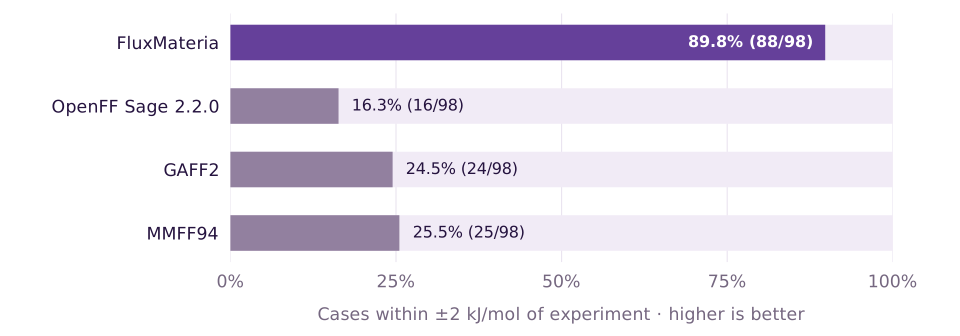
Evidence: internally executed comparison against experimental measurements. Values are recalculated from the published May 2026 case data, using the same 98 rows for every method. The full FluxMateria set contains 99 cases and has a reported MAE of 0.832 kJ/mol. The common-cohort figure above is 0.839 kJ/mol; no prediction has been changed.
| Measured result | FluxMateriaFLUX physical theory | OpenFF Sage2.2.0 | GAFF2gaff-2.11, AmberTools 25.1 | MMFF94RDKit implementation |
|---|---|---|---|---|
| Mean absolute errorkJ/mol · lower is better | 0.839 | 9.725 | 11.041 | 14.077 |
| Within ±2 kJ/molHigher is better | 89.8%88 / 98 cases | 16.3%16 / 98 cases | 24.5%24 / 98 cases | 25.5%25 / 98 cases |
| Error relative to FluxMateriaComparator MAE / FluxMateria MAE | 1.0× | 11.6× | 13.2× | 16.8× |
| FluxMateria reduces MAE byRelative to each comparator | Reference | 91.4% | 92.4% | 94.0% |
| Absolute MAE reductionkJ/mol versus each comparator | Reference | 8.886 | 10.202 | 13.238 |
Read the comparison protocol and its limits
- The published force-field protocol uses 24-angle relaxed dihedral scans. FluxMateria supplies a direct barrier prediction. The target quantity and molecules are shared; the computational procedures differ.
- The common cohort includes every row with a numeric prediction from all four methods. One case, 1,3-cyclohexadiene, has no force-field scan result in the published file and is excluded from every method in this comparison.
- MAE and threshold counts are recomputed from published predictions and experimental values. Small last-digit differences from the original summary reflect rounded exported rows.
- This is a FluxMateria-run benchmark on an experimental reference set, not a completed independent blind replication.
- The result concerns these versions and this endpoint. OpenFF has released later Sage versions, including 2.3.0; they were not evaluated in this saved comparison.
- OPLS-4, GFN2-xTB and DFTB were not run on this cohort. This comparison establishes no numerical ranking against them.
- Multireference and excited-state torsions are outside the benchmark scope; transition-metal organometallic torsions are not yet validated. A barrier benchmark does not by itself validate complete conformer populations or binding affinities.
A separate materials snapshot also records millisecond predictions
The February 2026 universal-materials snapshot evaluates a separate 16-output path. It provides additional throughput and coverage evidence alongside the 40+ property profile and DFT comparison above.
The universal materials benchmark reports a mean of 2.741 ms and a median of 2.417 ms per prediction call across a 16-output validation path. The snapshot records 743 successful predictions from 856 attempted material queries, with 113 failed queries.
This materials path has a mixed prediction basis, as documented on its benchmark page. Its runtime is separate evidence of throughput; it is not a measured speedup over Sage, GAFF2, MMFF94, xTB or DFTB. The saved torsion comparison does not include a matched wall-clock timing study.
Why electronic-structure and AI tools remain in use. Electronic-structure methods calculate quantities such as electronic states, forces and stresses; learned potentials approximate reference calculations at lower computational cost. Established fast methods also remain useful for their supported tasks. FLUX’s contribution is assessed through its own physical predictions and measured performance, with scope stated for each result. See Quantum ESPRESSO’s capability description and research on fast learned potentials.
Put the advantage to an independent test
Choose the property and cases that matter to your work. Agree the input contract, baseline and scoring before the run. Keep experimental targets hidden, freeze predictions before unblinding, and score every case, including failures. That is how a published advantage becomes evidence for your application.
Prepared 1 October 2026. The materials accuracy chart uses the downloadable May 2026 Tier 1 export; its breadth chart uses the Tier 3 panel. DFT batch timing is transcribed from the full benchmark page’s reported measured totals. Other torsion, band-gap and Caco-2 figures use published May 2026 data; the additional materials runtime snapshot is from February 2026. This page compares existing results and documented capabilities; it adds no new physical predictions or independent replication.